
Costume DIY
How to Make a Halloween Costume: Three Principles of the Hand-Built Costume
The Architecture of a Haunting Costume
A memorable costume is never bought — it is built. What separates a character from a look is silhouette, texture, and the single unsettling detail the eye can't let go of. This is how to make a Halloween costume that people remember past the night itself — three principles from the atelier, and how to execute each one on a thrift-store budget and two free weekends.
Before You Build: Choose the Shape of the Fear
Decide what your character is before you decide what it wears. A revenant? A wraith? Something that was once respectable? Write it in one sentence — "a drowned bride, still waiting at the water's edge" — and every material decision afterward answers to it. Budget honestly: under $40 is possible with found clothing and matte face paint; under $100 buys real structure. Plan two weekends — one to build, one to distress and rehearse.
1. Start with the Silhouette
Before fabric, decide the shape the body will cut against the dark. A towering figure needs volume at the shoulders and a long, narrow hem. A creeping figure needs broken lines — asymmetry, hunched posture, fabric that pools at the floor.
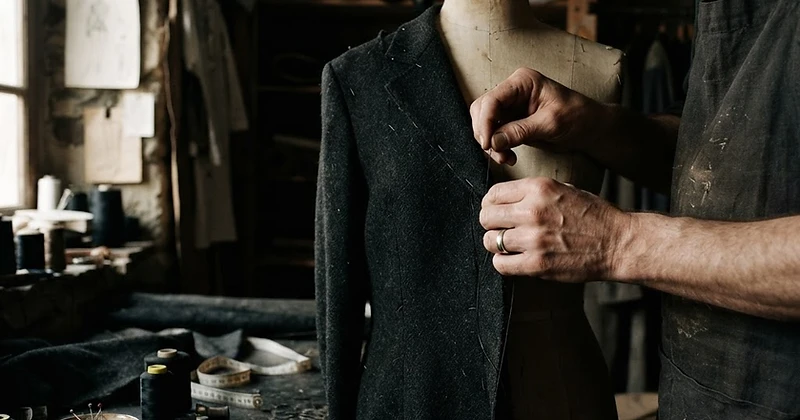
In practice: shoulder volume is cheap. Batting, foam pads, or a thrifted jacket worn backward and stuffed will widen any frame. Length is easier than width — a raw-hemmed secondhand cape moves differently than anything tailored. Test in a doorway with the lights off. If the shape doesn't read as wrong in silhouette alone, it won't read at all.
2. Choose One Wrong Material
Every great costume pairs the expected with one thing that shouldn't be there. A formal wool suit, but burned at the cuffs. A lace collar, but made of painted paper. The brain reads the mismatch before it reads the costume, and that friction is what lingers.
The discipline is the word one. Two wrong materials read as a costume party; a single mismatch reads as evidence. Coffee-stain your fabric, drag it behind a car, bury it for a week — distressing is free, and it is the difference between "dressed as" and "became."
3. Obscure the Face Last
The mask is the final note, not the first. Build the body of the costume, then decide how much of the self to remove. A featureless white mask reads as absence. A sheer black stocking over the face reads as distortion. Both are more powerful than any licensed rubber.
A full-face knit like a horror balaclava does the same work in one purchase — total concealment with the lights still on. A filigree lace mask hides less and unsettles more: the face is visible, and the wrongness is in the pattern. Whichever route you take, rehearse the walk. A masked face with an unmasked walk is a costume. A masked walk is a haunting.
Common Mistakes
- Starting with the mask. It is the last note, not the first.
- Buying the wig before the silhouette. Shape before surface, always.
- Forgetting movement. A costume that can't sit, hold a glass, and climb stairs is a photograph, not a night out.
- Over-distressing. Ruin is seasoning, not the meal.
Build or Buy
Some years you have the time to build; some Octobers you do not. If it is the latter, the same three principles apply to buying: choose the silhouette first (a cloak transforms whatever is under it), accept one wrong detail (wraith-cloth instead of costume satin), and finish with the disciplined mask. The Dark Editions were built on exactly these principles — cloaks, masks, and one-piece silhouettes that do the work of a built costume straight off the hanger.
Restraint is the discipline. One uncanny detail outperforms ten.