
Halloween History
A Brief History of Halloween: The Night the Veil Thinned
The Original Masquerade
Before the plastic masks and the candy hauls, Halloween was a liminal night — a threshold between the harvest and the dark. The Celts called it Samhain (pronounced sow-in), the moment when the veil between worlds grew thin enough to step through. Held at the turning of November, it marked the end of the pastoral year: herds brought down from the summer pastures, the last harvests stored, the long dark beginning. Samhain was not a festival of fun. It was a rite of survival — a night to honor the dead, read the winter ahead, and take precautions against both.
The Costume as Disguise
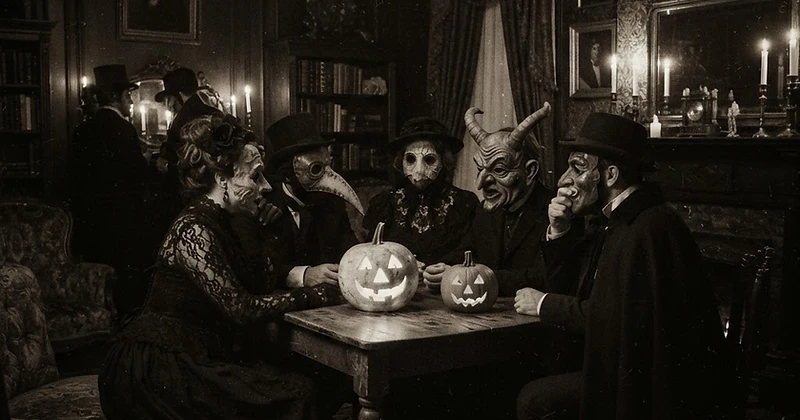
Dressing on October 31st began as survival. To step outside after dark was to risk being recognized — and taken — by the things that walked the roads on a night like this. So villagers wore masks, smeared their faces with ash, and reversed their coats to walk unrecognized among the dead. The costume was not decoration. It was armor.
That logic survived every century that followed. Mummers and guisers kept the mask alive; the Victorians turned it into parlor theater; Hollywood turned it into an industry. The oldest instinct remains the truest: on Halloween, you dress as something else so that something else passes you by.
From Turnips to Pumpkins
The first jack-o'-lanterns were not carved from pumpkins at all. In the boggy soils of Ireland and Scotland, families hollowed out turnips and rutabagas, carving grim faces to ward off wandering spirits. The legend behind them — the tale of Stingy Jack, who tricked the devil twice and was barred from both heaven and hell, condemned to wander the dark with a single coal glowing inside a hollowed turnip — gave the lantern its name and its purpose: a light for the damned, set on a windowsill to keep the walking dead moving past the door.
When Irish immigrants arrived in America, they found the native pumpkin — larger, softer, and far more generous a canvas — and the tradition was reborn.
A turnip jack-o'-lantern, gnarled and small, still carries something a pumpkin cannot: the genuine dread of scarcity, of a long winter ahead.
The Church Renames the Night
In the 8th century, the Catholic Church fixed All Saints' Day on November 1st, and the evening before became All Hallows' Eve — hallowed evening, Halloween. What followed was not erasure but layering. All Souls' Day, November 2nd, brought "souling": the poor went door to door offering prayers for the dead in exchange for soul cakes. Children in costume performing for food — guising — grew from the same root. Trick-or-treating is older than it looks.
The Victorians Make It Strange and Romantic
The 19th century made Halloween elegant. Parlor games — bobbing for apples to learn whom you would marry, walnut-shell boats set adrift in water basins, mirrors draped at midnight — turned divination into evening entertainment. Mourning culture supplied the wardrobe: black gowns, veils, crepe. A holiday of survival became a holiday of controlled fear, dressed in lace. Our Veiled Widow and the Victorian silhouettes in the Dark Editions belong to this chapter of the story.
America Standardizes the Haunt
Post-war suburbia gave trick-or-treat its current shape: costumes, candy, porch lights. The horror cinema of the 1970s and '80s gave the night its modern palette. Today Halloween is a multi-billion-dollar season — nearly half of it spent on costumes — and every September, searches for the history of Halloween spike again. The holiday survived by shapeshifting. That is rather the point.
The Lineage We Honor
This is the lineage we build from: not the cartoon, but the rite. A plague doctor's beak is history, not fantasy — The Leech wears eight centuries of quarantine. A witch hat is a folk memory. The Scrying Glass is what the Victorians actually stared into. The costume was armor once, and it still is — just against a duller enemy now. The veil thins every year, whether we notice or not. The costume is how we notice.